Common Electric Pallet Truck Hazards and How to Avoid Them
Electric pallet trucks are a familiar sight in warehouses, factories, distribution centers, retail facilities, and production areas. They help operators move palletized goods faster, reduce manual effort, and improve everyday material handling efficiency.
Because these trucks are compact and relatively easy to operate, however, their risks can sometimes be underestimated.
A heavy pallet, a narrow aisle, a wet floor, poor visibility, or one rushed movement can quickly turn a routine handling task into an accident.
Understanding the most common electric pallet truck hazards, and knowing how to manage them, is an important part of creating a safer and more efficient workplace.
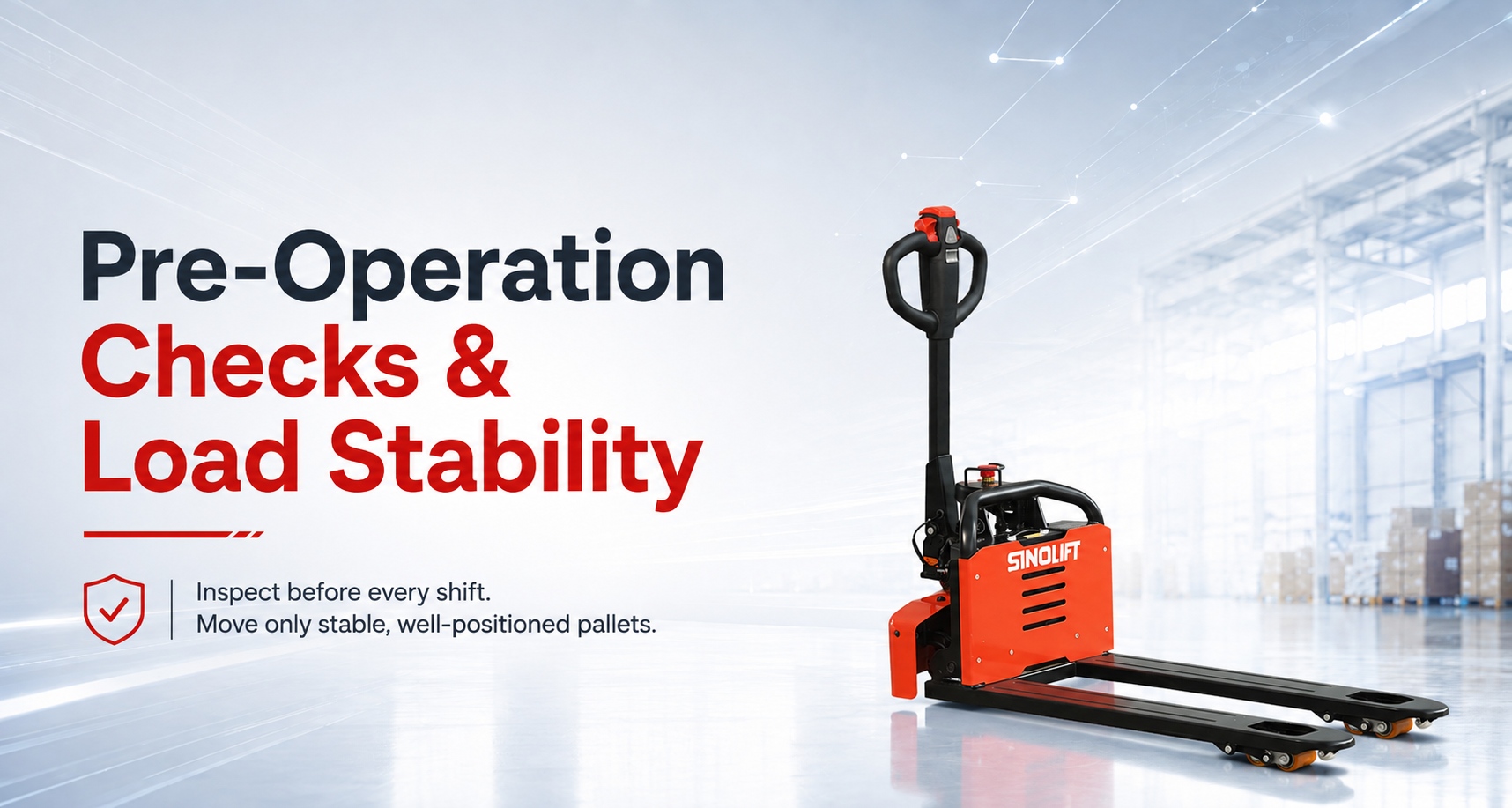 Start with a Pre-Operation Inspection
Many potential problems can be identified before the truck even begins moving.
Worn wheels, damaged forks, hydraulic leaks, low battery power, faulty brakes, loose electrical connections, or unresponsive controls can all affect the truck's performance and safety.
Before each shift, operators should check the general condition of the truck, including the forks, wheels, battery connections, control buttons, horn, steering, lifting system, brakes, and emergency functions.
A brief low-speed test in a clear area can also help identify unusual noises, poor steering response, braking problems, or other abnormal behavior.
If something does not look, sound, or feel right, the truck should be taken out of service until the problem has been inspected and corrected.
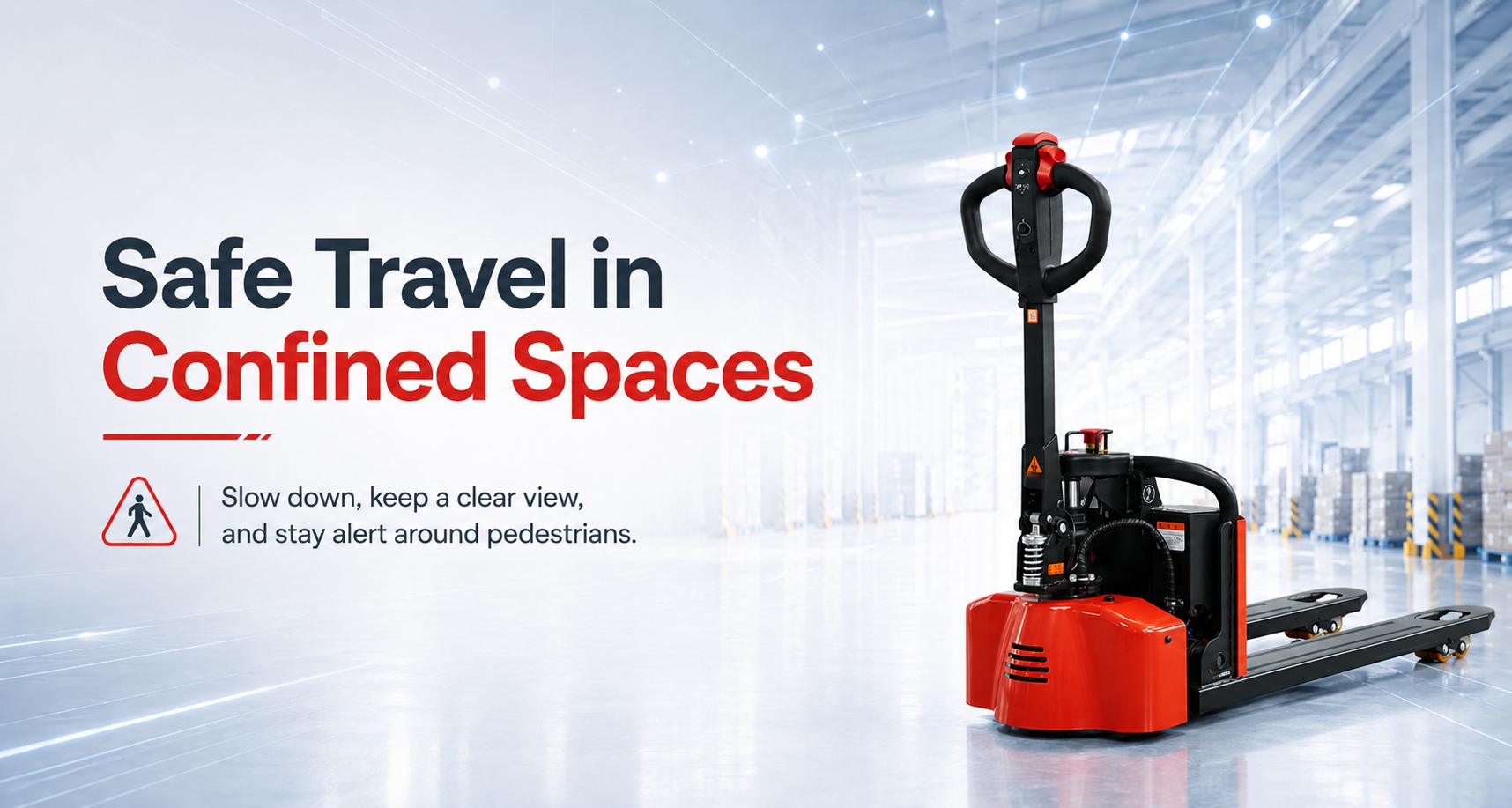 Protect Hands and Feet Around the Truck
Pedestrian electric pallet trucks operate very close to the user. This makes crushing, trapping, and pinch-point injuries an important concern.
Feet can become trapped near the wheels or chassis, while hands may be exposed around the forks, lifting mechanism, pallet, or load.
Whenever possible, operators should position themselves slightly to the side of the truck rather than directly in its travel path. Hands and feet should remain clear of wheels, forks, and other moving components.
Extra care is especially important when reversing, turning, or repositioning the truck in a confined area.
Emergency reverse functions and other safety features can provide additional protection, but they should support good operating habits rather than replace them.
Keep Control in Narrow Aisles and Confined Areas
Electric pallet trucks are frequently used in spaces where every centimeter matters: narrow warehouse aisles, trailers, elevators, production lines, storage rooms, and loading areas.
In these environments, the operator needs to think about the movement of the entire truck, not just the forks and pallet.
During a turn, the drive unit can swing outward and create a collision or crushing risk against racks, walls, equipment, or nearby workers.
Reducing speed before turning and allowing enough clearance around the truck are simple but important precautions.
Where available, a low-speed or turtle-speed mode can make precise positioning easier in tight spaces. Smooth steering, controlled acceleration, and gradual braking also help the operator maintain better control.
Match Travel Speed to the Working Environment
There is no single safe operating speed for every situation.
The appropriate speed depends on floor condition, load size, visibility, pedestrian traffic, aisle width, and the amount of space available for stopping and turning.
Water, oil, loose packaging, dust, uneven flooring, and other surface hazards can reduce traction or interfere with the wheels. A truck that feels stable on a clean warehouse floor may behave very differently on a slippery loading area.
Operators should reduce speed when approaching corners, intersections, doorways, ramps, loading zones, or areas with frequent pedestrian traffic.
When carrying a heavy load, smooth acceleration and gradual braking become even more important.
Do Not Ignore Load Stability
Rated capacity matters, but load weight is only part of the story.
Even when a pallet is within the truck's specified capacity, it may still be unsafe if the load is poorly stacked, damaged, off-center, or unevenly distributed.
Loose packaging, broken pallets, unstable cartons, and irregular loads can shift during acceleration, braking, or turning.
Before moving the pallet, operators should make sure the load is stable and the pallet is suitable for transport. The forks should be inserted correctly and the load positioned as evenly as possible.
Tall, wide, long, or irregular loads require additional attention because they can reduce visibility and become less stable during turns.
If the load cannot be transported safely in its current condition, it should be rearranged, secured, or handled using a more suitable solution.
Watch for Pedestrians
In many facilities, people and material handling equipment share the same working area.
Blind corners, intersections, doorways, loading zones, production lines, and narrow aisles are particularly sensitive locations.
Operators should maintain a controlled travel speed, stay alert to pedestrian movement, and use the horn when approaching areas with restricted visibility.
A large pallet can also block the operator's forward view. In this situation, continuing to travel without a clearly visible path can significantly increase collision risk.
Clearly marked traffic routes, pedestrian walkways, warning signs, mirrors, barriers, and good communication between employees can help create a safer traffic environment.
Take Extra Care Around Loading Docks and Platforms
Loading docks, trailers, dock plates, tail lifts, and raised platforms introduce hazards that are less common on normal warehouse floors.
Before entering a trailer or crossing a dock plate, operators should confirm that the surface is properly positioned, secured, and suitable for the combined weight of the truck and load.
Trailers should also be properly restrained according to site procedures before loading or unloading begins.
Near exposed dock edges, operators should maintain a safe distance and move at a controlled speed. Never assume that a trailer, dock plate, or platform is secure simply because it appears to be in position.
Operating on Slopes and Ramps
Slopes affect both truck control and load stability.
Excessive speed, sudden braking, or attempting to turn on a ramp can cause the load to shift or make the truck more difficult to control.
Electric pallet trucks should only be used on slopes permitted by the manufacturer and the workplace's operating procedures.
Travel slowly, avoid unnecessary turns on the slope, and keep pedestrians away from the truck's path.
The safest travel direction may depend on the truck design, gradient, load, and operating environment. Operators should therefore follow the manufacturer's instructions for the specific equipment being used rather than relying on a general rule.
Park the Truck Properly
A parked pallet truck can still create a hazard if it is left in the wrong place or with the forks raised.
Before leaving the equipment unattended, the forks should be lowered completely, the controls returned to a safe position, and the truck switched off. Keys or access devices should be removed where applicable.
Parking areas should be kept away from emergency exits, walkways, slopes, loading zones, and other high-traffic locations.
If the truck is not operating normally, it should be reported and removed from service rather than left for the next operator to discover the problem.
Pay Attention to Battery and Charging Safety
The battery is central to the performance of an electric pallet truck, but incorrect charging or damaged electrical components can create operational and safety problems.
The truck should be charged in an appropriate area using a charger that matches the battery's voltage and charging requirements.
Before charging, the truck should be switched off and the battery cables, plugs, and connectors checked for visible wear, corrosion, or damage.
Battery installation, removal, repair, and maintenance should only be carried out by trained or authorized personnel.
Used batteries and damaged electrical components should also be handled and disposed of according to applicable local environmental and safety requirements.
Training Matters More Than Safety Features Alone
Modern electric pallet trucks may include electromagnetic braking, low-speed modes, emergency reverse buttons, battery indicators, emergency power switches, and other safety functions.
These features are valuable, but they cannot compensate for poor judgment or inadequate training.
Operators should understand how the truck accelerates, turns, stops, lifts, and behaves under load. They should also know its rated capacity, operating limitations, emergency controls, and basic inspection requirements.
Just as importantly, training should reflect the real working environment.
A truck used in an open warehouse may face very different risks from one operating inside trailers, along production lines, around pedestrians, or in extremely narrow aisles.
Refresher training is also useful when new equipment is introduced, warehouse layouts change, or operating procedures are updated.
Safer Handling Starts with Everyday Decisions
Many electric pallet truck incidents do not begin with a major mechanical failure.
They often begin with something much smaller: skipping an inspection, entering a corner too quickly, transporting an unstable pallet, working with poor visibility, or continuing to use equipment that does not feel right.
Daily inspections, trained operators, stable loads, controlled driving, and well-managed traffic routes can prevent many common handling risks.
Choosing the right equipment matters as well.
Capacity, fork dimensions, truck size, turning radius, battery configuration, control functions, and safety features should all match the actual load and working environment.
SINOLIFT provides electric pallet trucks and material handling solutions for different warehouse layouts, load requirements, and operating conditions.
Tell us what you need to move, your load capacity, pallet size, and working environment, and our team can help you identify a suitable handling solution.
WhatsApp/Tel: +86 189 1727 6010
Email: global@sinolift.com
Website: www.sinolift.com
SINOLIFT CPD500-R720 Electric Clamping Truck for Smoother Roll Handling
Which Manual Stacker Works with Your Pallet? A Guide to Pallet Types and Stacker Selection
Related Article